

JEE Main 2027 Complete Guide
Full Program · Duration: 1 Years
JEE Main is a national-level engineering entrance examination conducted by NTA for admission to NITs, IIITs and other participating institutes, and for qualifying for JEE Advanced.
Enquire NowJEE Main (Joint Entrance Examination - Main) is India's national-level engineering entrance examination conducted by the National Testing Agency (NTA).
For engineering aspirants, JEE Main primarily serves two purposes:
- Admission to NITs, IIITs and other participating institutes.
- Qualification for JEE Advanced, which is the entrance examination for IITs.
The basic pathway is:
Class 12 → JEE Main → NIT / IIIT / GFTI Admission
For students who qualify for JEE Advanced:
Class 12 → JEE Main → JEE Advanced → IIT Admission
1. What is JEE Main?
JEE Main stands for Joint Entrance Examination - Main. It is conducted by the National Testing Agency (NTA).
JEE Main is primarily used for admission to undergraduate engineering programmes such as B.E. and B.Tech. at NITs, IIITs and other participating institutes.
It is also the qualifying examination for students who want to appear for JEE Advanced and subsequently compete for admission to the IITs.
The admission process for IITs, NITs, IIITs and other participating institutes is conducted through the JoSAA counselling system, subject to the applicable rules.
2. Who Should Give JEE Main?
JEE Main is primarily suitable for students who want to pursue undergraduate programmes in engineering and technology.
- B.E.
- B.Tech.
- B.Arch.
- B.Planning
The most popular paper is:
Paper 1 - B.E. / B.Tech.
Paper 1 tests three subjects:
- Physics
- Chemistry
- Mathematics
3. Eligibility for JEE Main
For JEE Main 2026, candidates who passed Class 12 or equivalent in 2024 or 2025, or were appearing in Class 12 in 2026, were eligible, subject to the detailed conditions specified by NTA.
There is no upper age limit for appearing in JEE Main itself.
Eligibility for B.E. / B.Tech.
Students should have studied Physics and Mathematics along with one of Chemistry, Biology, Biotechnology or a relevant technical vocational subject, as prescribed by the applicable eligibility rules.
Number of Attempts
JEE Main is conducted in two sessions in a year.
A candidate can generally appear in JEE Main for three consecutive years from the year of passing Class 12, subject to the applicable NTA rules.
Therefore, a student may potentially have six examination-session opportunities by appearing in both sessions during the three eligible years.
4. Is 75% Required for JEE Main?
No minimum Class 12 percentage is generally required merely to appear for JEE Main.
However, for admission to NITs, IIITs and other institutes under the NIT+ system, candidates generally need:
- At least 75% aggregate marks in Class 12.
- OR to be within the top 20 percentile of their respective board.
For SC/ST candidates, the applicable minimum aggregate is generally 65%, subject to the official admission rules.
Therefore, a student can appear for JEE Main even without 75% marks, but may not satisfy the academic eligibility for admission to an NIT, IIIT or GFTI.
5. JEE Main Exam Pattern
For Paper 1 (B.E. / B.Tech.), the current JEE Main pattern consists of Physics, Chemistry and Mathematics.
| Subject | MCQs | Numerical Questions | Total Questions | Marks |
|---|---|---|---|---|
| Physics | 20 | 5 | 25 | 100 |
| Chemistry | 20 | 5 | 25 | 100 |
| Mathematics | 20 | 5 | 25 | 100 |
| Total | 60 | 15 | 75 | 300 |
Exam Duration
The duration of Paper 1 is generally 3 hours.
Marking Scheme
- Correct answer: +4 marks
- Incorrect answer: -1 mark
- Unattempted question: 0 marks
The maximum score for Paper 1 is 300 marks.
6. What is NTA Percentile?
JEE Main uses the NTA Score / percentile system rather than simply declaring a student's performance as a percentage.
Percentile is not the same as percentage marks.
For example, a student scoring 99 percentile has performed better than approximately 99% of candidates considered under the relevant normalization and ranking framework.
The raw marks and percentile can vary depending on the difficulty of the examination shift and the performance of candidates.
7. JEE Main Sessions
JEE Main is generally conducted in two sessions during the year.
- Session 1
- Session 2
Students can use the second session as an opportunity to improve their performance.
When a candidate appears in both sessions, the better applicable overall NTA Score is considered for ranking.
8. JEE Main Syllabus
JEE Main Paper 1 covers Physics, Chemistry and Mathematics from the prescribed Class 11 and Class 12 syllabus.
I. Mathematics Syllabus
Algebra
- Sets, Relations and Functions
- Complex Numbers
- Quadratic Equations
- Matrices and Determinants
- Permutations and Combinations
- Binomial Theorem
- Sequence and Series
Calculus
- Limits
- Continuity
- Differentiability
- Application of Derivatives
- Integral Calculus
- Differential Equations
Coordinate Geometry
- Straight Lines
- Circles
- Conic Sections
Vector and 3D Geometry
- Vector Algebra
- Three-Dimensional Geometry
Other Topics
- Statistics
- Probability
- Trigonometry
II. Physics Syllabus
Mechanics
- Units and Measurements
- Kinematics
- Laws of Motion
- Work, Energy and Power
- Rotational Motion
- Gravitation
Properties of Matter
- Properties of Solids
- Properties of Liquids
Thermal Physics
- Thermodynamics
- Kinetic Theory
Oscillations and Waves
- Oscillations
- Waves
Electricity
- Electrostatics
- Current Electricity
Magnetism
- Magnetic Effects of Current
- Magnetism
Electromagnetic Physics
- Electromagnetic Induction
- Alternating Current
- Electromagnetic Waves
Optics
- Ray Optics
- Wave Optics
Modern Physics
- Dual Nature of Matter and Radiation
- Atoms
- Nuclei
- Electronic Devices
III. Chemistry Syllabus
Physical Chemistry
- Some Basic Concepts in Chemistry
- Atomic Structure
- Chemical Thermodynamics
- Solutions
- Equilibrium
- Redox Reactions
- Electrochemistry
- Chemical Kinetics
Organic Chemistry
- Organic Chemistry - Basic Principles
- Hydrocarbons
- Haloalkanes and Haloarenes
- Alcohols, Phenols and Ethers
- Aldehydes, Ketones and Carboxylic Acids
- Amines
- Biomolecules
- Practical and related Organic Chemistry topics
Inorganic Chemistry
- Periodic Classification of Elements
- Chemical Bonding
- p-Block Elements
- d-Block and f-Block Elements
- Coordination Compounds
- Metallurgy-related concepts
- Environmental Chemistry and prescribed related topics
9. JEE Main Difficulty Level
JEE Main is a highly competitive examination. The difficulty of individual shifts can vary, so students should not prepare based on the assumption that one subject will always be easy.
Mathematics
Mathematics is often time-consuming and requires extensive problem-solving practice.
Physics
Physics requires conceptual understanding, formula application and numerical problem-solving ability.
Chemistry
Chemistry can provide significant scoring opportunities when students have strong NCERT knowledge, conceptual clarity and sufficient practice.
10. How Much Score Should I Target?
There is no universal safe score for JEE Main because the required percentile and rank depend on the year, shift, number of candidates, category, college, branch and counselling rules.
| Target | Broad Goal |
|---|---|
| Qualification | Cross the applicable qualifying percentile |
| Good NIT / IIIT Possibilities | 97-99+ percentile |
| Strong NIT Branches | 99+ percentile |
| Highly Competitive CSE / ECE | 99.5-99.9+ percentile may be required |
| Elite NIT CSE | Extremely high percentile / rank generally required |
These are broad planning ranges and should not be treated as guaranteed admission cut-offs.
11. JEE Main Qualifying Cut-Off
The qualifying cut-off is the minimum percentile required to become eligible for JEE Advanced, subject to the applicable rules.
| Category | JEE Main 2026 Qualifying Percentile |
|---|---|
| General / UR | 93.4123549 |
| EWS | 82.4164528 |
| OBC-NCL | 80.9232583 |
| SC | 63.9172792 |
| ST | 52.0174712 |
| UR-PwBD | 0.0023186 |
Important: These are JEE Advanced qualifying cut-offs. They are not the admission cut-offs for NITs, IIITs or GFTIs.
12. Qualifying Cut-Off vs Admission Cut-Off
Qualifying Cut-Off
This determines whether a student becomes eligible for JEE Advanced, subject to the applicable eligibility conditions.
Admission Cut-Off
This determines whether a student can receive admission to a particular college and branch through the applicable counselling process.
Admission cut-offs are generally represented through opening and closing ranks.
Therefore:
Qualifying JEE Main percentile does not guarantee an NIT CSE seat.
13. JEE Advanced Connection
Students who want admission to IITs need to qualify for and appear in JEE Advanced.
For JEE Advanced 2026, the top 2,50,000 successful candidates in the B.E./B.Tech. paper of JEE Main 2026 were eligible, subject to the detailed JEE Advanced eligibility conditions.
The pathway is:
JEE Main → Top 2.5 Lakh Approx. → JEE Advanced → Rank → JoSAA → IIT
14. Which Colleges Can You Get Through JEE Main?
JEE Main can provide admission opportunities to NITs, IIITs and other participating institutes through the applicable counselling process.
A. National Institutes of Technology (NITs)
Some prominent NITs include:
- NIT Trichy
- NIT Surathkal
- NIT Warangal
- NIT Rourkela
- NIT Calicut
- MNNIT Allahabad
- NIT Delhi
- NIT Kurukshetra
- MNIT Jaipur
- VNIT Nagpur
- NIT Durgapur
- NIT Silchar
- NIT Jamshedpur
- NIT Hamirpur
- NIT Patna
B. Indian Institutes of Information Technology (IIITs)
Some prominent IIITs include:
- IIIT Allahabad
- IIITDM Jabalpur
- IIITDM Kancheepuram
- IIIT Lucknow
- IIIT Guwahati
- IIIT Pune
- IIIT Nagpur
- IIIT Ranchi
- IIIT Kota
- IIIT Sri City
The admission process and eligibility can differ for individual institutes, so students should always check the institute-specific rules.
C. GFTIs
JEE Main is also used for admission to various Government Funded Technical Institutes (GFTIs).
The quality and programmes of GFTIs vary significantly, so students should evaluate each institute individually.
15. Can JEE Main Get You Into IIT?
No.
JEE Main itself does not provide direct IIT admission.
For IIT admission, students must follow:
JEE Main → JEE Advanced Qualification → JEE Advanced → JoSAA → IIT
16. Branches Available Through JEE Main
Computer and Technology
- Computer Science and Engineering
- Information Technology
- Artificial Intelligence
- Data Science
- Electronics and Communication Engineering
Core Engineering
- Mechanical Engineering
- Electrical Engineering
- Civil Engineering
- Chemical Engineering
- Production Engineering
- Metallurgical Engineering
- Materials Engineering
- Instrumentation Engineering
- Mining Engineering
Other Programmes
- Engineering Physics
- Biotechnology
- Environmental Engineering
- Industrial Engineering
Does Rank Matter More Than Percentile?
For college and branch selection, rank is generally more useful than simply looking at percentile.
A small difference in percentile at the very high end can represent a substantial difference in rank.
Therefore, students should ultimately focus on:
Rank → College → Branch
Home State Quota
NIT admissions have an important distinction between Home State and Other State seats.
Depending on the institute and category, the closing rank for a branch may differ significantly between Home State and Other State candidates.
Therefore, a student should not ask only:
"What percentile is required for NIT?"
A more useful question is:
"What rank is required for this branch, in this NIT, for my category and state quota?"
Reservation
Reservation is implemented according to the applicable Government of India rules and counselling framework.
- General / OPEN
- GEN-EWS
- OBC-NCL
- SC
- ST
- PwD categories as applicable
Candidates should check the latest JoSAA Business Rules for the exact seat allocation and reservation framework.
17. JEE Main Admission Process
-
Appear for JEE Main
NTA conducts the JEE Main examination.
-
Receive NTA Score and Rank
NTA releases the examination result and ranking information.
-
Register for JoSAA
Eligible candidates participate in the JoSAA counselling process.
-
Fill College and Branch Preferences
Students arrange their preferred colleges and branches.
-
Seat Allocation
JoSAA conducts seat allocation rounds.
-
Seat Acceptance
Students complete the applicable seat acceptance process.
-
Document Verification
Required documents are verified.
-
Fee Payment
Students pay the applicable fees.
-
Institute Reporting
Students complete the final admission and joining formalities.
What If I Don't Get a Seat in JoSAA?
Students may also have opportunities through the Central Seat Allocation Board (CSAB) special rounds for eligible vacant seats.
Therefore:
JoSAA is not necessarily the end of all admission opportunities.
18. JEE Main Preparation Strategy
The most effective preparation approach is:
Learn → Practice → Test → Analyse → Improve → Revise
Students should not wait until the entire syllabus is complete before starting tests.
Phase 1 - Foundation
The objective of the foundation phase is to build strong conceptual understanding.
- Understand basic concepts.
- Study NCERT and classroom material.
- Learn important formulas.
- Solve fundamental questions.
- Build problem-solving habits.
At this stage, students should focus on accuracy and understanding rather than extremely difficult questions.
Phase 2 - JEE Main Level Practice
Once concepts are clear, students should move towards:
- Topic-wise questions
- Chapter-wise questions
- Previous Year Questions
- Mixed practice
- Timed practice
A good chapter cycle is:
Theory → Examples → Practice → PYQs → Timed Test → Revision
Phase 3 - Exam Simulation
The final stage should focus heavily on examination simulation.
- Full-length tests
- Part-syllabus tests
- Subject-wise tests
- Previous-year papers
- Shift-wise papers
- Three-hour simulations
The objective should change from:
"Can I solve this?"
to:
"Can I solve this correctly and quickly under examination conditions?"
19. How Many Questions Should a Student Solve?
There is no scientifically meaningful universal target such as "solve 10,000 questions."
Quality of practice is more important than the raw number of questions.
Students should focus on:
- Questions solved correctly
- Questions understood after making mistakes
- Questions solved within the required time
- Questions that expose weak concepts
20. Importance of Previous Year Questions
Previous Year Questions are one of the most important components of JEE Main preparation.
- Chapter-wise PYQs
- Recent-year PYQs
- Shift-wise PYQs
- Full-paper PYQs
PYQs help students understand:
- Question style
- Difficulty level
- Repeated concepts
- Time requirements
- Question framing patterns
21. Mathematics Preparation Strategy
Mathematics requires extensive and consistent problem-solving practice.
A useful cycle is:
Concept → Illustration → Basic Questions → PYQs → Timed Set → Revision
Students should maintain an error log for questions they get wrong.
22. Physics Preparation Strategy
Physics should not be prepared only through formula memorisation.
Use:
Concept → Equation → Physical Interpretation → Application → PYQ
For every important formula, students should understand:
- What the formula represents.
- When it can be used.
- What assumptions are involved.
- The relevant units.
- Limiting cases and physical meaning.
23. Chemistry Preparation Strategy
Physical Chemistry
Focus on concepts, formulas and numerical practice.
Organic Chemistry
Focus on reaction mechanisms, reaction patterns and regular revision.
Inorganic Chemistry
Strong NCERT-based preparation is extremely important.
24. Daily Study Strategy
A practical study structure can include:
| Study Block | Suggested Time |
|---|---|
| Mathematics | 2-3 Hours |
| Physics | 1.5-2 Hours |
| Chemistry | 1.5-2 Hours |
| Revision / PYQs | 1-2 Hours |
The actual study schedule should be adjusted according to the student's school schedule, preparation stage and individual capacity.
25. Error Analysis
Error analysis is one of the most important habits for improving JEE Main performance.
Every mistake should be classified.
- Conceptual Error: The concept was not understood.
- Application Error: The concept was known but could not be applied.
- Calculation Error: The approach was correct but the calculation went wrong.
- Reading Error: The question was misunderstood.
- Time Management Error: Too much time was spent on one question.
- Guessing Error: An unnecessary risk was taken.
26. Mock Test Strategy
A mock test is useful only when it is properly analysed.
Use:
Test → Analysis → Correction → Retest
Students should track:
| Metric | Track |
|---|---|
| Total Score | Yes |
| Physics Score | Yes |
| Chemistry Score | Yes |
| Mathematics Score | Yes |
| Accuracy | Yes |
| Attempted Questions | Yes |
| Wrong Questions | Yes |
| Unattempted Questions | Yes |
| Time per Subject | Yes |
| Silly Mistakes | Yes |
27. Recommended Test Frequency
Early Preparation
Approximately 1 test per week.
Mid Preparation
Approximately 1-2 tests per week.
Final 2-3 Months
Approximately 2-4 tests per week, depending on the student's readiness.
Final Month
Focus on full-paper simulations and intensive analysis.
Students should not take tests continuously without analysing their mistakes.
28. How to Attempt the JEE Main Paper
There is no universally correct subject order. Students should identify their ideal order through mock tests.
Common combinations include:
- Chemistry → Physics → Mathematics
- Physics → Chemistry → Mathematics
- Mathematics → Physics → Chemistry
The best order is the one that produces the highest score with controlled risk and efficient time management.
29. Three-Round Attempt Strategy
Round 1
Solve questions that can be answered quickly and confidently.
Round 2
Solve moderate-level questions that require some calculation or thought.
Round 3
Return to lengthy, difficult or uncertain questions if sufficient time remains.
Students should focus on maximising expected marks rather than attempting every question blindly.
30. What Rank Should I Target?
Students should set a rank target rather than only a percentile target.
- Top 1,000
- Top 5,000
- Top 10,000
- Top 25,000
- Top 50,000
The target rank should be based on the student's desired college and branch.
31. Approximate Percentile Interpretation
| Percentile | Broad Interpretation |
|---|---|
| 99.9+ | Extremely Strong |
| 99.5-99.9 | Excellent |
| 99-99.5 | Very Strong |
| 98-99 | Strong |
| 95-98 | Good Range |
| 90-95 | Requires Careful College and Branch Strategy |
| Below 90 | Options Depend More on Category, State and Institute |
These are broad planning ranges and should not be treated as guaranteed admission cut-offs.
32. NIT vs IIIT vs GFTI
NIT
NITs generally provide a broad engineering ecosystem with programmes such as:
- Computer Science
- Electronics
- Electrical
- Mechanical
- Civil
- Chemical
- Other engineering disciplines
IIIT
IIITs are often more technology-focused and can be particularly attractive for students interested in:
- Computer Science
- Information Technology
- Artificial Intelligence
- Data Science
- Electronics and technology-related programmes
GFTI
GFTIs vary significantly in terms of academic programmes, placements, infrastructure and reputation. Students should evaluate each institute individually.
33. What If I Don't Get an NIT?
Not getting an NIT does not mean the end of an engineering career.
Depending on the student's rank and state, alternatives may include:
- IIITs
- GFTIs
- State Government Engineering Colleges
- State Counselling
- University-specific admissions
- Private Universities
- Other Engineering Entrance Examinations
34. Other Engineering Entrance Exams
Students may also consider other engineering entrance examinations, depending on their eligibility and career goals.
- JEE Advanced
- BITSAT
- VITEEE
- MET
- SRMJEEE
- COMEDK
- WBJEE
- MHT-CET
- KCET
- AP EAMCET / EAPCET
- TS EAMCET / EAPCET
- Other State CETs
- University-specific entrance examinations
35. JEE Main vs JEE Advanced
| Feature | JEE Main | JEE Advanced |
|---|---|---|
| Main Purpose | NIT / IIIT / GFTI Admission + JEE Advanced Qualification | IIT Admission |
| Conducting Authority | NTA | IIT System |
| Subjects | Physics, Chemistry, Mathematics | Physics, Chemistry, Mathematics |
| Difficulty | High | Higher and More Conceptual |
| Admission | NIT / IIIT / GFTI and participating institutes | IITs |
| Counselling | JoSAA / CSAB | JoSAA |
36. Preparation Strategy for Class 11 Students
Class 11 is the ideal stage to build strong fundamentals.
- Build strong conceptual foundations.
- Follow the syllabus systematically.
- Solve JEE-level questions regularly.
- Take chapter and unit tests.
- Avoid accumulating backlogs.
- Revise completed chapters regularly.
37. Preparation Strategy for Class 12 Students
Class 12 students need to balance board examination preparation with JEE preparation.
Students should try to build a preparation system where conceptual understanding supports both board examinations and competitive examinations.
38. Preparation Strategy for Droppers
A dropper should not simply repeat the previous year's preparation.
First identify the reason for the previous performance:
- Conceptual weakness
- Incomplete syllabus
- Poor question practice
- Poor time management
- Insufficient mock tests
- Weak revision
- Inconsistency
- Exam anxiety
- Careless mistakes
The drop year should then focus on:
Concept Repair + PYQs + Tests + Analysis + Revision
39. Biggest JEE Preparation Mistakes
- Collecting too many books and resources.
- Watching lectures without solving enough questions.
- Ignoring Chemistry.
- Avoiding difficult Mathematics topics.
- Not solving PYQs.
- Taking mock tests without analysing them.
- Changing teachers and resources repeatedly.
- Studying only favourite chapters.
- Ignoring revision.
- Comparing scores with other students instead of tracking personal progress.
40. Best JEE Preparation Formula
A strong preparation cycle can be represented as:
Concept Clarity → Quality Practice → PYQs → Timed Tests → Error Analysis → Revision → Retest → Improvement
41. What Should a Good JEE Test Series Contain?
A comprehensive JEE Main test series should ideally contain:
1. Chapter Tests
Tests covering individual chapters after completion.
2. Unit Tests
Tests covering multiple related chapters.
3. Part Tests
Tests covering a significant portion of the syllabus.
4. Full-Length Tests
Complete 75-question, 300-mark JEE Main simulations.
5. Previous-Year Paper Tests
Actual previous-year papers converted into timed examination simulations.
6. Shift-Based Tests
Tests designed to simulate actual JEE Main shift conditions.
7. Detailed Solutions
Solutions should explain the approach instead of providing only the final answer.
8. Performance Analytics
- Score
- Percentile estimate
- Accuracy
- Subject-wise performance
- Chapter-wise performance
- Time analysis
- Attempt analysis
- Wrong-question analysis
9. All-India Ranking
Students should be able to understand their position relative to other test takers.
10. Improvement System
Students should be able to revisit mistakes, reattempt questions and measure improvement over time.
42. What Should Students Track?
- Total Score
- Percentile
- All India Rank
- Physics Accuracy
- Chemistry Accuracy
- Mathematics Accuracy
- Average Time per Question
- Silly Mistakes
- Conceptual Errors
- Unattempted Easy Questions
- Strong Chapters
- Weak Chapters
- Previous Test Score
- Current Test Score
43. Final Advice for JEE Aspirants
Students should not prepare for JEE Main simply to clear the qualifying cut-off.
The qualifying percentile only determines eligibility for the next stage such as JEE Advanced, subject to the applicable criteria. Admission to competitive NIT and IIIT branches generally requires a substantially stronger rank.
Therefore, students should focus on:
- Strong conceptual understanding
- Consistent problem solving
- Previous Year Questions
- Regular testing
- Detailed error analysis
- Revision
- Time management
- Accuracy
The ultimate objective should be:
Rank → College → Branch
44. JEE Main in One Page
| Area | Key Information |
|---|---|
| Conducting Body | National Testing Agency (NTA) |
| Main Paper | Paper 1 - B.E. / B.Tech. |
| Subjects | Physics, Chemistry and Mathematics |
| Mode | Computer Based Test |
| Duration | 3 Hours |
| Total Questions | 75 |
| Total Marks | 300 |
| Correct Answer | +4 |
| Wrong Answer | -1 |
| Sessions | Generally 2 per year |
| Age Limit | No upper age limit for appearing in JEE Main |
| Academic Eligibility for NIT/IIIT/GFTI | Generally 75% or Top 20 Percentile; applicable SC/ST criterion is 65% |
| JEE Advanced | Top 2,50,000 successful JEE Main B.E./B.Tech. candidates, subject to criteria |
| IIT Admission | Through JEE Advanced |
| NIT / IIIT / GFTI Admission | Through JoSAA / CSAB mechanisms |
| 2026 General Qualifying Cut-Off | 93.4123549 percentile |
| Best Preparation Method | Concept → Practice → PYQ → Test → Analysis → Revision |
45. JEE Main Complete Admission Journey
The complete journey of a JEE Main aspirant can be summarized as:
Class 10 → Class 11 PCM → JEE Preparation → Class 12 → JEE Main Session 1 → JEE Main Session 2 → JEE Advanced (if qualified) → JoSAA Counselling → College & Branch Allocation → Admission
Course Features
Live Classes
Recorded Lectures
Test Series
Study Material
Mentorship
Doubt Support
Videos
Video lessons for this course are coming soon.
Visit Our YouTube ChannelRelated Test Series
Test series included with the JEE Main 2027 Complete Guide program.
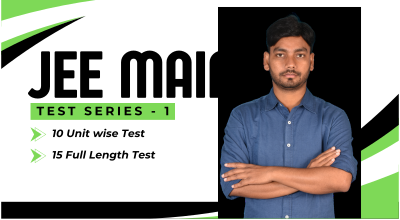
JEE Main 2027 Test Series 1
10 Unit wise Test, 15 Full Length Test, Detailed Solutions & Analytics, Try it anytime and anywhere.
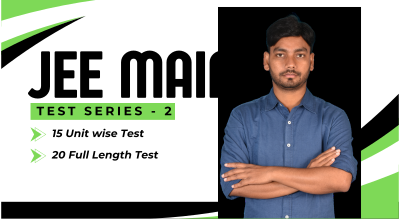
JEE Main 2027 Test Series 2
15 Unit wise Test, 20 Full Length Test, Detailed Solutions & Analytics, Try it anytime and anywhere.
Enquire Now
Tell us what you're preparing for and we'll get in touch within 24 hours.
Open Enquiry Form